If you’re a yarn artist, you know the struggles of getting yarn that is just right for a project, or trying to figure out what to do with leftover yarn. Not necessarily because there’s nothing to make, but because even yarns labeled with the same gauge can behave completely differently. They vary in thickness, ply, and stiffness, which makes mixing and matching more complicated than it sounds. I’ll tell you what I learned about yarn gauge and materials so hopefully your next project can be more well-informed!
In this post, I’m going to show you how important yarn selection is with Michaels brand (Loops and Threads) Impeccable Acrylic (sage green), Joann’s Big Twist (pink), and Loops and Threads Soft Classic Solid Yarn (safety orange).
What is yarn gauge?
Yarn gauge is basically a way to describe how thick or thin a yarn is. You will usually see it grouped into categories like lace, fingering, DK, worsted, or bulky. It is meant to help you choose the right yarn for a pattern so your project comes out the right size and shape.
Here’s what you would find in the yarn aisle:
| Yarn Weight Number | Common Name(s) |
| 0 | Lace |
| 1 | Super Fine (Fingering, Sock) |
| 2 | Fine (Sport) |
| 3 | Light (DK, Light Worsted) |
| 4 | Medium (Worsted, Aran) |
| 5 | Bulky |
| 6 | Super Bulky |
| 7 | Jumbo |
That said, gauge is more of a guideline than a rule. Two yarns can both be labeled “worsted” and still feel totally different in your hands. One might be softer or looser spun, another tighter, heavier, or stiffer. Those differences affect how the yarn drapes, stretches, and holds structure, which is why swapping yarns is not always as simple as matching the label.
What is ply?
Yarn ply refers to how many individual strands are twisted together to make a single piece of yarn. For example, a 2-ply yarn is made from two strands twisted together, while a 4-ply yarn uses four. Ply affects how the yarn feels and behaves more than people often expect.
Yarns with fewer plies tend to feel softer and more airy, but they can split more easily while you are working. Yarns with more plies are usually stronger, smoother, and more defined, which makes stitches look sharper and the finished piece more durable. This is why two yarns with the same gauge can still look and act very differently once you start crocheting or knitting with them.
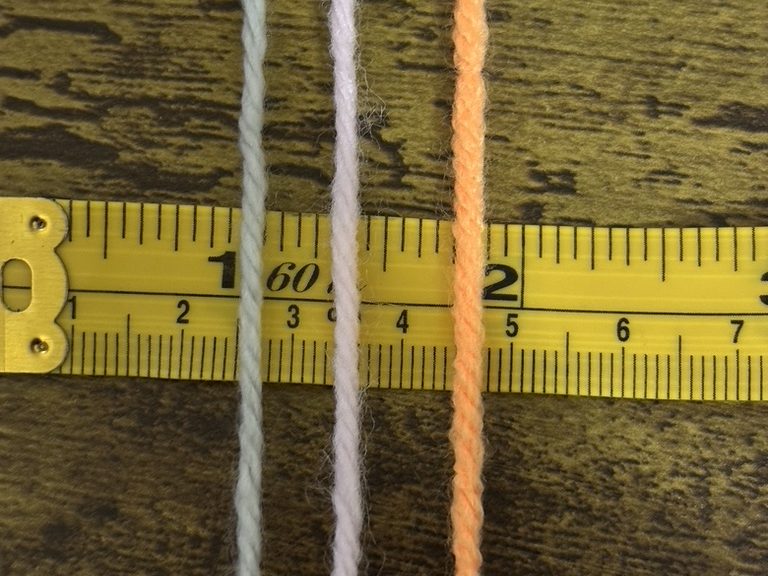
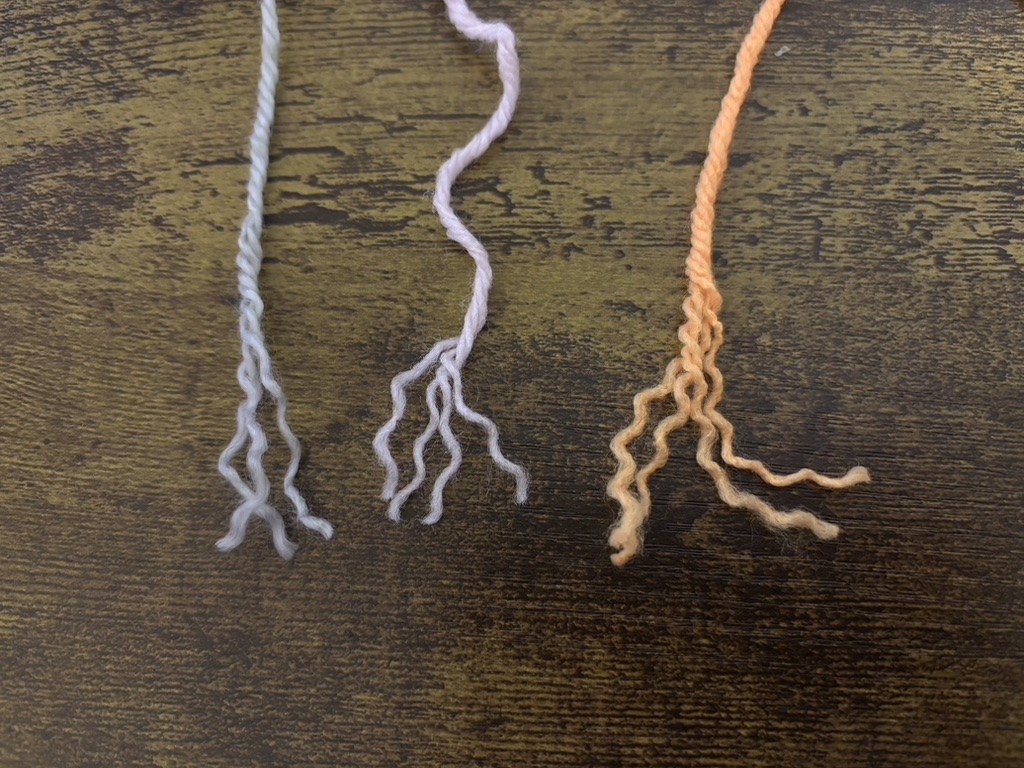
From left to right, here is the Michaels brand (Loops and Threads) Impeccable Acrylic, Joann’s Big Twist, and Loops and Threads Soft Classic Solid Yarn. I’ve split up the end to show how many strands are twisted together. Sage green shows three threads, and the pink and orange both show four strands. The sage green is quite soft while the pink is quite stiff and sturdy, and the orange is somewhere in between.
How different can yarn be if they’re the same gauge?
I’ll show you. I have three different brands of 4/worsted yarn. As you can see, the difference in thickness is subtle but there!
I’ve made some circles using these instructions, using a 3.5mm hook and about the same tension for each of them:
MR, ch1 to secure
R1: ch3, 11dc, slst into top of ch3. Pull tight (12 dc)
R2: ch3, dc in same st (inc), dc inc in each st until the end. Slst into top of ch3 (24 dc)
Normal words:
Create a magic ring, chain 1 to secure
R1: chain 3, make 11 double crochets, slip stitch into the top of the chain 3. Pull tight (12 double crochets)
R2: chain 3, double crochet into the same stitch as where the chain 3 originates. Create two double crochets in each stitch from R1 until the end. Slip stitch into the top of the chain 3 (24 double crochets)
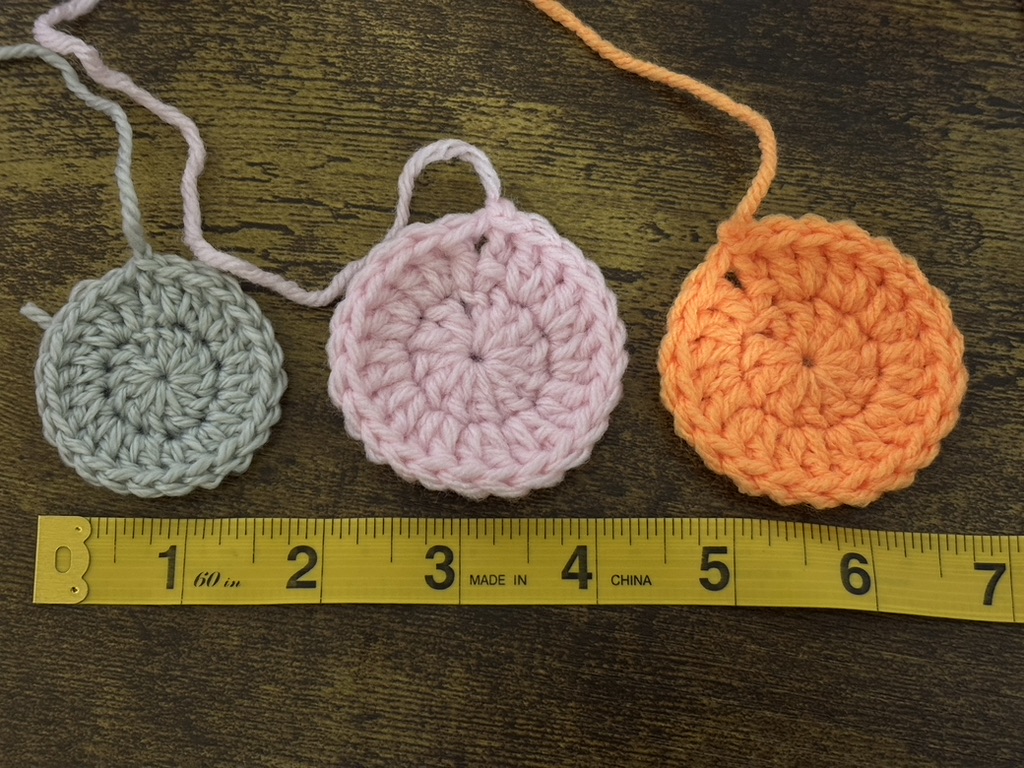
After making my circles, it’s even more evident how different these yarns are! They even feel drastically different. The sage green is still soft and pliable, but both the pink and orange are very stiff and hold their shape if I fold them. They would probably get softer after a wash, but it’s something to take into account when figuring out what kind of yarn I want to use for clothes vs a blanket vs amigurumi for example.
What can I do if my yarns are too different?
My sage green yarn was super skinny compared to the other two yarns shown in this post. If I wanted to get it to a similar thickness, I could work the sage green yarn with another skinnier yarn to add some thickness, such as a lace or sport weight yarn. This is also a great option if you want to create some color variation but don’t have or can’t find the right yarn to do it!
How do I keep track of yarns that I work with?
Everyone organizes differently, but I simply save the labels and clip off a piece of yarn so I can tape it on the label so I still have a sample of the yarn to reference. Not all skeins (bundles of yarn) come with a label but that can be solved with something like an index card with all of the details. I have my labels organized just by labeled weight for now since I generally work with a select few yarn brands for consistency sake.
I hope this helps someone out! Happy crocheting!
 Loop Theory Creations